
Frequently Asked Questions
About Canadian ImmigrationHave a Question About Canadian Immigration?
Browse the questions below. If you are ready to discuss your specific situation, book a consultation and our team will review your matter directly.
What immigration services do you provide?
Our team provides Canadian immigration consulting services for individuals, families, and employers. Our services may include consultations, eligibility assessments, application strategy, full representation, procedural guidance, and support with complex immigration matters. We assist with temporary residence, permanent residence, family sponsorship, Provincial Nominee Programs, work permits, study permits, visitor visas, admissibility concerns, appeals, and humanitarian and compassionate applications.
Do you serve clients outside Canada?
Yes. We serve clients in Canada and around the world. Our office is based in Calgary, Alberta, but many of our consultations and immigration services are provided remotely to clients located internationally. Whether you are inside Canada, outside Canada, or planning your first application to Canada, we can review your situation and help identify potential immigration options.
Are you a regulated Canadian immigration firm?
Yes. Our firm is led by Mohamed Negmeldin, RCIC-IRB, a Regulated Canadian Immigration Consultant authorized to provide Canadian immigration consulting services within the scope permitted by the College of Immigration and Citizenship Consultants. Clients should always confirm that their immigration representative is properly licensed before receiving paid immigration advice.
What does RCIC-IRB or Level 3 Unrestricted licence mean?
Our Principal Consultant, Mohamed Negmeldin, RCIC-IRB, holds a Level 3 Unrestricted licence, which authorizes him to provide immigration consulting services and represent clients before the Immigration and Refugee Board of Canada, within the permitted scope of practice. This is important for clients who may need assistance with sponsorship appeals, removal order appeals, admissibility hearings, detention reviews, or other complex immigration proceedings before the IRB.
Do you have a Saskatchewan-licensed immigration consultant?
Yes. Our Principal Consultant, Mohamed Negmeldin, RCIC-IRB, is licensed by the Government of Saskatchewan to provide immigration consulting services for matters where Saskatchewan is the client's intended destination. This includes, but is not limited to, SINP-related services.
How can I verify your credentials?
You can verify the licence and standing of any regulated Canadian immigration consultant through the College of Immigration and Citizenship Consultants (CICC) public register at www.cicc.ca. Our Licence and Accreditation page links directly to the relevant public registers for each of our consultants.
Do I need a consultation before hiring your team?
In many cases, yes. A consultation allows our team to review your immigration history, goals, documents, eligibility, risks, and possible options before determining the appropriate next steps. This is especially important if you have previous refusals, status issues, inadmissibility concerns, employment-related immigration needs, multiple possible pathways, or you are looking for all available permanent residence options.
What happens during an immigration consultation?
During the consultation, our Principal Consultant may review your personal circumstances, education, work experience, language ability, family situation, immigration history, previous applications, refusals, Canadian ties, employer support, and long-term goals. The purpose of the consultation is to help you understand possible immigration pathways, risks, documentation needs, and practical next steps.
Who conducts the immigration consultation?
Your consultation will be conducted by our Principal Consultant, Mohamed Negmeldin, RCIC-IRB. Mohamed reviews your circumstances, immigration goals, documents, risks, and possible options before recommending next steps.
Can I book a consultation remotely?
Yes. We offer consultations by phone and video for clients located anywhere in Canada or abroad. You do not need to be in Calgary or physically present at our office to book or attend a consultation.
Can you guarantee approval?
No. No immigration consultant, lawyer, or representative can guarantee approval of an immigration application. Final decisions are made by Immigration, Refugees and Citizenship Canada, the Canada Border Services Agency, provincial immigration authorities, or the Immigration and Refugee Board. Our team provides professional guidance, strategy, document preparation, and representation, but approval is never guaranteed.
Can I book a consultation if I already had a refusal?
Yes. Clients with previous refusals are encouraged to book a consultation before submitting a new application. A refusal may affect future applications, especially if the same weaknesses are repeated. Our team can review the refusal reasons, previous submissions, supporting documents, and possible strategy for a stronger resubmission or alternative pathway.
Can you help with permanent residence applications?
Yes. Our team can assist with different permanent residence pathways, depending on the client's eligibility. This may include Express Entry, Provincial Nominee Programs, family sponsorship, humanitarian and compassionate applications, and other federal or provincial programs. Each pathway has different requirements, processing considerations, documentation standards, and risks.
What is Express Entry?
Express Entry is Canada's online system for managing certain permanent residence applications, including the Federal Skilled Worker Program, Canadian Experience Class, Federal Skilled Trades Program, and some Provincial Nominee Program streams. Candidates are ranked using the Comprehensive Ranking System (CRS). A candidate usually needs to receive an Invitation to Apply before submitting a permanent residence application through Express Entry.
Can you help improve my Express Entry profile?
Our team can review your Express Entry eligibility, CRS score, education credentials, language test results, work experience, NOC/TEER classification, proof of funds, family composition, and possible provincial nomination options. While CRS score improvement depends on the client's circumstances, we can help identify areas that may affect ranking and eligibility.
What is a Provincial Nominee Program?
A Provincial Nominee Program (PNP) allows Canadian provinces and territories to nominate eligible candidates for permanent residence based on local labour market, economic, demographic, or regional priorities. Each province has its own streams, eligibility rules, scoring systems, employer requirements, occupation priorities, and documentation expectations.
Can you help with AAIP, OINP, SINP, BC PNP, MPNP, and other PNPs?
Yes. Our team assists clients with Provincial Nominee Program matters, including Alberta AAIP, Ontario OINP, Saskatchewan SINP, British Columbia BC PNP, Manitoba MPNP, and other provincial pathways where appropriate. Because PNP rules change frequently, eligibility should be reviewed carefully before applying.
Can you help with PR card renewal?
Yes. Our team can assist with PR card renewal, including reviewing your travel history, residency days, supporting evidence, and any issues that may affect the application. A PR card renewal application may raise questions about whether the residency obligation has been met.
What is the residency obligation?
Permanent residents generally need to meet an applicable residency obligation. Certain time outside Canada may count in defined circumstances, and humanitarian considerations may be relevant in some cases. A detailed travel history and evidence review are important before filing a PR card or Permanent Resident Travel Document application where compliance is uncertain.
Can you help with Canadian citizenship applications?
Yes. Our team can assist with citizenship eligibility assessments, physical presence calculations, documentation, language requirements, and application preparation. We can also assist individuals who need to determine or prove whether they are already Canadian citizens by birth, descent, or parentage.
What if my citizenship or permanent residence application is delayed?
MDIC offers consultations for delayed temporary residence, permanent residence, sponsorship, and citizenship matters. The review may include the timeline, communication history, records requests, webform follow-up, and possible escalation options. Deadlines and available remedies vary by application type.
Can you help with visitor visas?
Yes. Our team can assist with visitor visa applications, including strategy, documentation, purpose of travel, financial support, family ties, country of residence ties, previous travel history, and previous refusal concerns. Visitor visa applications should clearly address the applicant's temporary purpose and intention to comply with Canadian immigration rules.
Can you help with study permits?
Yes. Our team can assist with study permit applications, including review of the program of study, financial documents, study plan, ties to the home country, previous education and employment history, and previous refusals. A strong study permit application should explain why the program makes sense and how the applicant meets the requirements to study in Canada.
Can you help with work permits?
Yes. Our team can assist with different types of Canadian work permit matters, including employer-specific work permits, LMIA-supported work permits, LMIA-exempt work permits, spousal open work permits, post-graduation work permit questions, and other temporary worker matters. The correct work permit strategy depends on the applicant's job offer, employer, location, occupation, immigration history, and eligibility.
What is a Post-Graduation Work Permit (PGWP)?
A Post-Graduation Work Permit allows eligible graduates of designated Canadian institutions to work in Canada after completing their studies. Eligibility depends on the program, institution, length of study, and application timing. A PGWP can be an important step toward gaining Canadian work experience and qualifying for permanent residence.
What is the difference between an LMIA-supported and LMIA-exempt work permit?
An LMIA-supported work permit usually requires the Canadian employer to first obtain a positive Labour Market Impact Assessment from Employment and Social Development Canada before the foreign worker applies for a work permit. An LMIA-exempt work permit may be available under specific exemptions, international agreements, public policies, or other immigration categories. Eligibility depends on the facts of the case.
Can you assist Canadian employers?
Yes. Our team assists Canadian employers with immigration-related matters, including LMIA strategy, foreign worker support, work permit planning, employer compliance considerations, and documentation review. We help employers understand immigration requirements before hiring or supporting a foreign worker.
Do you help with LMIA applications?
Yes. Our team can assist employers with LMIA-related strategy and application preparation, depending on the circumstances. LMIA applications require careful attention to recruitment, wage, job duties, business legitimacy, labour market need, and supporting documentation.
Can you help employers hire foreign workers?
Yes. Our team can help employers understand whether a foreign worker may need an LMIA, whether an LMIA exemption may apply, what documents may be required, and what immigration risks should be considered before proceeding. Employers should obtain proper advice before making employment offers that depend on immigration approval.
Can you help with spouse, common-law partner, or partner sponsorship?
Yes. Our team can assist with family sponsorship applications for a spouse, common-law partner, or eligible partner, including inland and outside Canada sponsorship, relationship evidence, forms, document review, previous refusal concerns, and procedural strategy. Partner sponsorship applications should clearly demonstrate that the relationship is genuine and meets the applicable legal requirements.
Can you help with parent and grandparent sponsorship?
Yes. Our team can assist with parent and grandparent sponsorship matters, including eligibility review, income considerations, document preparation, and application strategy when the program is available. We may also review super visa options where appropriate.
Can you help with dependent child sponsorship?
Yes. Our team can assist with dependent child sponsorship applications, including eligibility review, custody or consent documents where applicable, family relationship documents, and immigration forms. Each case should be reviewed carefully, especially where there are custody, adoption, guardianship, or non-accompanying parent issues.
Can you help if I was denied boarding or denied entry to Canada?
Yes. If you were not permitted to board a flight to Canada or were denied entry at a Canadian port of entry, MDIC can review the available records, stated concerns, your status, and possible next steps. Prompt review is important as options may be time-sensitive.
What is a Temporary Resident Permit (TRP)?
A Temporary Resident Permit may allow a person who is inadmissible or does not otherwise meet an immigration requirement to enter or remain in Canada when justified by the circumstances. It is discretionary and requires a careful explanation of the need, risk, and supporting evidence.
Can you help with previous misrepresentation concerns?
Yes. Our team can review matters involving alleged or possible misrepresentation, including previous forms, documents, refusal letters, procedural fairness letters, and immigration history. Misrepresentation is a serious issue and may lead to refusal or inadmissibility consequences. Clients should obtain professional advice before responding to immigration authorities.
Can you help with procedural fairness letters?
Yes. Our team can assist with reviewing and responding to procedural fairness letters. These letters often indicate that an immigration officer has concerns about the application and is giving the applicant an opportunity to respond. The response should be prepared carefully and supported with relevant evidence.
Can you help with inadmissibility issues?
Yes. Our team may assist with certain inadmissibility matters, including immigration history concerns, previous non-compliance, misrepresentation allegations, medical or criminality-related concerns, and other issues depending on the case. Some inadmissibility matters may require coordinated legal or specialized support depending on complexity.
Can you help with humanitarian and compassionate applications?
Yes. Our team can assist with humanitarian and compassionate (H&C) applications where appropriate. These applications require a detailed review of hardship, establishment in Canada, family circumstances, best interests of any affected children, and other relevant compassionate factors.
Can you help with refugee claims and appeals?
MDIC's principal consultant holds an RCIC-IRB licence, which permits representation before the Immigration and Refugee Board of Canada within the authorized scope. Refugee, humanitarian, and protection matters require individual evidence, credibility assessment, legal analysis, and strict deadline management. Suitability depends on the matter, deadlines, conflict checks, and capacity.
Can you prepare the full application for me?
Yes. Our team may provide full representation services for eligible matters. This may include strategy, document checklist, form preparation, evidence review, submission support, correspondence monitoring, and communication with the relevant immigration authority where authorized. The scope is defined in a written service agreement.
Should I disclose previous refusals or immigration issues?
Yes. Applicants should be truthful and complete in their immigration applications. Previous refusals, visa denials, removals, overstays, inadmissibility findings, or immigration history issues may need to be disclosed. Failure to disclose relevant information can create serious problems, including possible misrepresentation concerns.
Can a small mistake affect my immigration application?
Yes. Even small mistakes can create problems if they affect eligibility, credibility, admissibility, identity, employment history, education, family composition, or previous immigration history. Forms and documents should be reviewed carefully before submission.
How do I start working with your team?
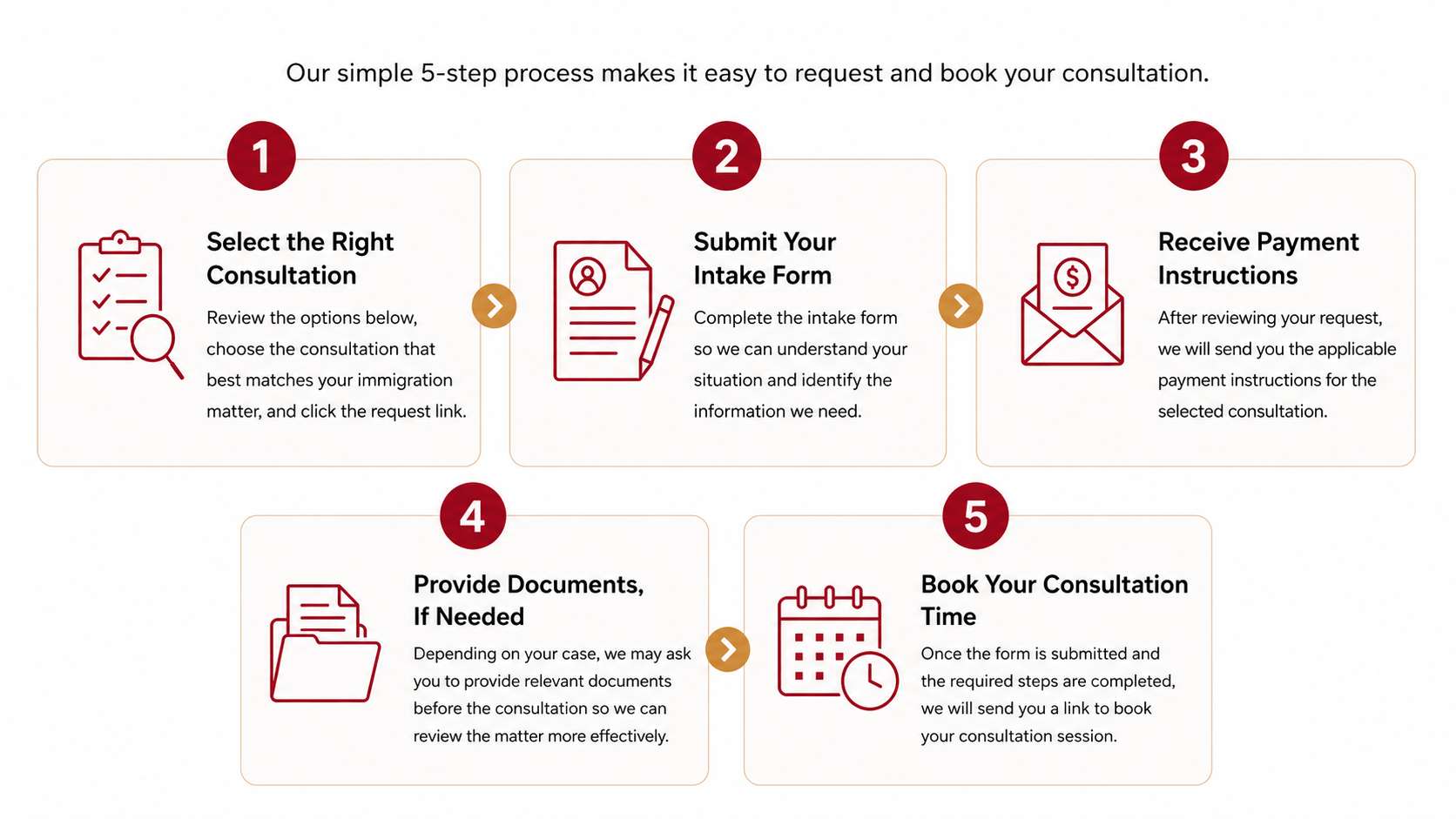
The first step is to book a consultation. Select the consultation type that most closely matches your situation on the Book a Consultation page and our team will review your matter and confirm next steps.
Are consultation fees separate from representation fees?
In many cases, consultation fees and representation fees are separate. If a client proceeds with further services, the applicable fee structure is confirmed in writing through a service agreement.
Will I receive a written service agreement?
Yes. For representation services, clients should receive a written service agreement that explains the scope of work, fees, responsibilities, and other important terms. A written agreement helps ensure that both the client and the representative understand the service being provided.
How long does an immigration application take?
Processing times vary depending on the program, immigration authority, completeness of the application, background checks, document requests, country of residence, and other factors. Our team can help clients understand general timing considerations, but processing times are ultimately controlled by the relevant government authority.
Is the information on this FAQ page legal advice?
No. This FAQ page provides general information only. It is not legal advice and does not create a consultant-client relationship. Canadian immigration rules, policies, and procedures change frequently. Please book a consultation for advice based on your specific facts, documents, and immigration history.
Follow Us
Start a WhatsApp Chat
